
Is a Montana LLC Right for Your Motorhome? Key Questions to Ask Before Registering

Montana LLC motorhome registration allows buyers to avoid sales tax by titling the vehicle under a Montana business entity, but the strategy works best for high-value RVs and full-time travelers rather than weekend users in high-enforcement states.
- The LLC costs $300 to $800 to form with annual fees around $35, and the break-even point is typically a vehicle worth $40,000 to $60,000 depending on your home state tax rate.
- States like California, Oregon, Georgia, and Arizona actively pursue Montana-plated vehicles, so buyers with fixed addresses in these states face compliance risks and should consult a tax attorney.
- Full-time RVers who establish Montana domicile have the strongest legal position, while weekend users who store the motorhome near their primary home are most likely to draw scrutiny from state revenue departments.
A Montana LLC for motorhome registration is a legal strategy where RV owners form a limited liability company in Montana and register their motorhome under that business entity. Because Montana has no sales tax, this approach allows buyers to avoid paying state sales tax on their vehicle purchase - potentially saving tens of thousands of dollars on expensive motorhomes.
A $400,000 motorhome triggers a sales tax bill that can exceed $30,000 in many states. Montana LLC motorhome registration is a legal strategy that bypasses that tax entirely — because Montana has no sales tax. But it is not right for every buyer, and setting it up without asking the right questions first can create more problems than it solves.
This post is a self-qualification checklist. Work through each section and you will know, before you spend a dollar, whether this strategy fits your situation.
What Montana LLC Motorhome Registration Actually Does
A Montana LLC is a legal business entity formed under Montana state law. When the LLC purchases and registers a motorhome, the vehicle title sits in the LLC’s name — not yours personally. Montana charges no sales tax and no general use tax on vehicle purchases.
The LLC itself costs roughly $300–$800 to form through a registered agent service, depending on the provider. Annual maintenance fees are around $35 for the Montana state filing. Registration fees in Montana are based on vehicle age and weight, not purchase price.
On a $500,000 diesel pusher, the math is stark. A state with a 7% sales tax would collect $35,000 at the point of sale. Montana collects $0.
Question 1: How Much Is Your Motorhome Worth?
The savings from Montana LLC motorhome registration must outweigh the costs of formation, maintenance, and compliance. A rough break-even threshold sits around $40,000–$60,000 in vehicle value, depending on your home state’s tax rate.

Use this quick calculation:
- Find your home state’s sales tax rate (or combined rate if local taxes apply).
- Multiply that rate by the motorhome’s purchase price.
- Subtract the total cost to form and maintain the Montana LLC for 3–5 years.
- If the result is positive, the strategy likely pencils out financially.
For Class A diesel pushers, high-end Class B vans, and luxury Class C motorhomes, the numbers almost always work. For a $45,000 gas-powered Class C in a low-tax state, the margin gets thin.
Question 2: Where Do You Actually Park and Use the Motorhome?
This is the question most buyers skip — and it is the one that creates legal exposure.
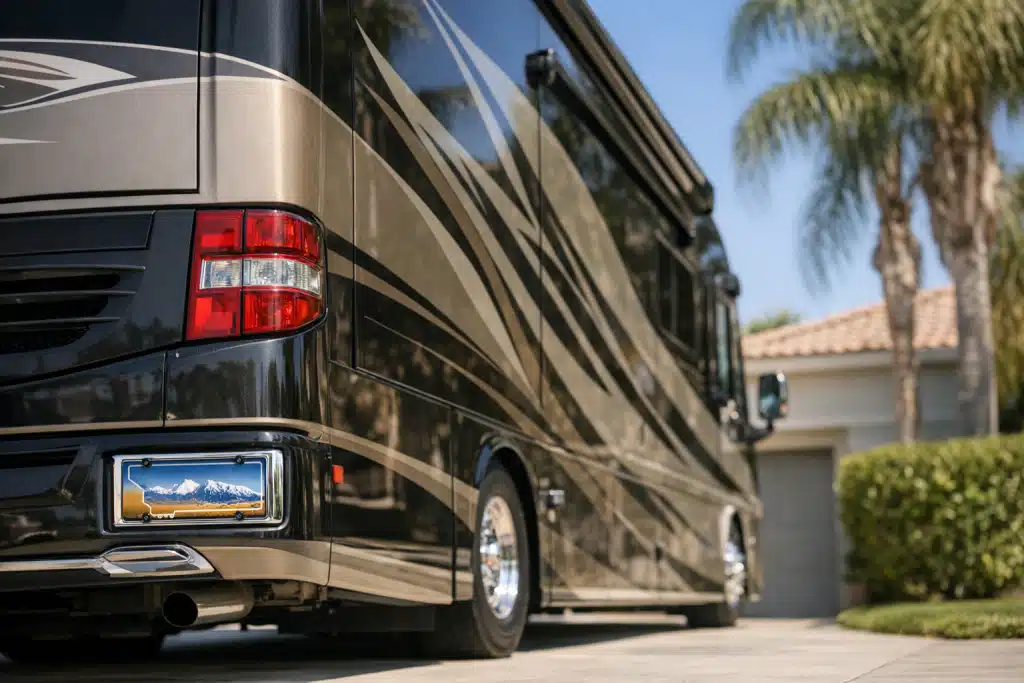
Your home state’s revenue department does not care where the vehicle is titled. They care where it is garaged or principally used. If a California resident parks a Montana-plated motorhome in their California driveway for eight months a year, California’s DMV and Board of Equalization view that as a California vehicle.
How States Define “Principally Garaged”
Most states use a combination of these tests:
- Physical location: Where does the vehicle spend most nights?
- Driver’s license state: Where is the primary operator licensed?
- Insurance state: Where is the vehicle insured?
- Duration: Some states trigger re-registration requirements after 30, 60, or 90 days of in-state presence.
Full-time RVers — people who truly have no fixed address — are in a different position than weekend campers who live in a traditional house. If you are a full-timer using Montana as your legal domicile, the strategy is straightforward. If you have a home in a high-enforcement state and park the rig nearby, your risk profile changes.
Question 3: What State Do You Live In?
Some states are aggressive about pursuing Montana LLC registrations. Others are largely indifferent. Knowing where your state falls changes your risk calculation before you ask yourself should I register my motorhome through a Montana LLC.
High-Enforcement States
California, Oregon, Georgia, and Arizona have all run enforcement campaigns targeting Montana-plated vehicles. California’s DMV sting operations have resulted in registration violations, back taxes, and penalties assessed against owners with Montana plates and California addresses.
Lower-Enforcement States
States with low or no sales tax — like Oregon, New Hampshire, Alaska, Delaware, and Montana itself — have little motivation to pursue this. If you live in one of them, the Montana LLC strategy may not save you much to begin with, since your home state does not charge sales tax either.
The honest answer: if you live in a high-tax, high-enforcement state and use the motorhome primarily from a fixed residential address, talk to a tax attorney before forming the LLC. The potential savings are real, but so is the compliance risk.
Question 4: Are You a Full-Timer, Seasonal Traveler, or Weekend User?
Your usage pattern matters as much as your home state.
Full-Time RVers
Full-timers who establish Montana as their legal domicile — meaning they get a Montana address through a mail forwarding service, obtain a Montana driver’s license, and register to vote there — have the strongest legal footing. They are Montana residents in a meaningful sense, and their vehicle is legitimately a Montana vehicle.
Seasonal and Long-Haul Travelers
People who spend six or more months per year traveling across multiple states, with no single state as their primary base, occupy a gray area. Many work with registered agents and document their travel carefully to demonstrate that no single state can claim them as a resident.
Weekend and Part-Time Users
Someone who uses the motorhome on weekends and holidays, then stores it near their primary home, is the profile most likely to draw scrutiny. The vehicle is functionally garaged in their home state. That does not automatically disqualify the Montana strategy, but it requires careful attention to storage location and documentation.
Question 5: What Are the Ongoing Compliance Requirements?
A Montana LLC is a real legal entity with real obligations. Skipping them can cause the LLC to lapse — and a lapsed LLC loses the registration protections that made it valuable in the first place.
Annual requirements include:
- Montana Annual Report: Filed with the Secretary of State, currently $35 per year for LLCs.
- Registered Agent: The LLC must maintain a registered agent with a physical Montana address at all times.
- Vehicle Registration Renewal: Montana registration must be renewed annually. The registered agent typically handles this on your behalf.
- Insurance: The vehicle must be insured, and the policy must reflect the LLC as the titled owner. Some insurers are accustomed to this structure; others are not.
A reputable service like TaxFree RV handles the annual filings, keeps the registered agent active, and sends renewal reminders — so the LLC does not quietly lapse because a form was missed.

 Posted on Google
Question 6: What Does Your Insurance Agent Say?
Insurance is one of the most overlooked parts of Montana LLC motorhome registration. The motorhome will be titled to an LLC, not to you personally. Some standard RV insurance policies do not cover vehicles owned by LLCs, or they require an endorsement that acknowledges the business ownership structure.
Before registering, call your insurance provider and ask two specific questions:
- Will you insure a motorhome titled to a Montana LLC under a personal RV policy?
- If not, do you offer a commercial auto or LLC-compatible policy, and what is the cost difference?
Most major RV insurers — including Good Sam, National General, and Progressive — have handled this structure before. The key is getting it in writing before the vehicle closes.
Question 7: Have You Talked to a Tax Professional?
This is not legal advice, and no blog post should substitute for a licensed tax attorney or CPA who knows your specific financial situation. The Montana LLC strategy is legal at the federal level and in Montana. Whether it creates liability in your home state depends on your state’s specific statutes, your usage patterns, and the documentation you maintain.
The buyers who run into trouble are the ones who form the LLC, put Montana plates on the motorhome, and then do nothing else to support the structure. The buyers who succeed treat it as a real business entity — because under Montana law, that is what it is.
The Montana LLC Motorhome Registration Self-Qualification Checklist
Run through these questions before moving forward:
- Vehicle value: Is the motorhome worth enough that the tax savings clearly exceed formation and maintenance costs?
- Home state taxes: Does your state charge sales tax or use tax on vehicles?
- Home state enforcement: Does your state actively pursue Montana-plated vehicles?
- Usage location: Will the motorhome be stored primarily outside your home state?
- Domicile status: Are you a full-timer, or do you have a fixed residential address?
- Insurance compatibility: Has your insurer confirmed they will cover an LLC-titled vehicle?
- Professional advice: Have you consulted a CPA or attorney familiar with your state’s rules?
- Compliance plan: Do you have a registered agent and renewal process in place?
If you answered “yes” to most of these, Montana LLC motorhome registration is worth pursuing. If several answers are “no” or “I don’t know,” those gaps need to close before you form the entity.
How TaxFree RV Fits Into This
TaxFree RV forms Montana LLCs for motorhome owners, handles the state registration, maintains the registered agent, and manages annual renewals. The formation process takes a few business days. You do not need to travel to Montana.
What TaxFree RV does not do is give legal or tax advice specific to your home state situation — and any company that offers blanket guarantees about state-level compliance without knowing your circumstances should be a red flag. The right registered agent service sets up the structure correctly and maintains it. Your attorney or CPA evaluates whether the strategy is appropriate for your specific situation.
If you have questions about how the registration process works or what is included in TaxFree RV’s formation package, reach out directly:
- Phone: 1‑888‑441‑5741
- Email: sales@taxfreerv.com
- Website: taxfreerv.com
Key Takeaways
Montana LLC motorhome registration is a legitimate, legal strategy that saves serious money on high-value coaches — but it is not automatically the right move for every buyer. Your home state’s enforcement posture, your actual usage pattern, and your willingness to maintain the LLC as a real entity all determine whether the strategy holds up.
Use the checklist above to self-qualify. If the boxes check out, contact TaxFree RV to get the LLC formed and the registration handled before your motorhome purchase closes.
Sources
- Montana Secretary of State – LLC Formation and Annual Report Requirements
- Montana Department of Revenue – Montana Tax Overview
- California DMV – Out-of-State and Foreign Vehicle Registration Requirements